

Building the Next Generation of Seaplanes in Canada
The Ocean 18, the Ocean 12, and the Manitoba opportunity
By Captain John S. Goulet, President, Goulet Aviation Services Ltd
Canada taught the world to fly into places without runways. The Bellanca, Norseman, PBY, Beaver, Otter, and Twin Otter opened the North, and generations of Canadian pilots have kept remote communities connected from lakes, rivers, and coastlines ever since. Manitoba knows this story as well as any: from the late 1950s into the mid-1960s, Transair, based out of my hometown of Lac du Bonnet, flew Canso amphibious flying boats on its northern routes, supporting the supply chains that connected Winnipeg, Churchill and the Arctic territories. Canada has built over 80 airports in the far north since then, but they represent only a fraction of the area not serviced by an airport. Yet current-day amphibious seaplanes cannot take up the slack.
Floatplanes, standard aircraft mounted on pontoons, do not have the range and water handling abilities that the original flying boats had. A purpose-built amphibious seaplane in this class has not entered production in decades, but not for lack of foresight. Aircraft engineers have used modern hydro- and aerodynamic analysis to design a new standard of amphibious seaplanes that have yet to be built. The seaplanes that replace the flying boats of the past will be built somewhere. There is a strong case that they should be built in Canada, and specifically in Manitoba.
A new generation of amphibians
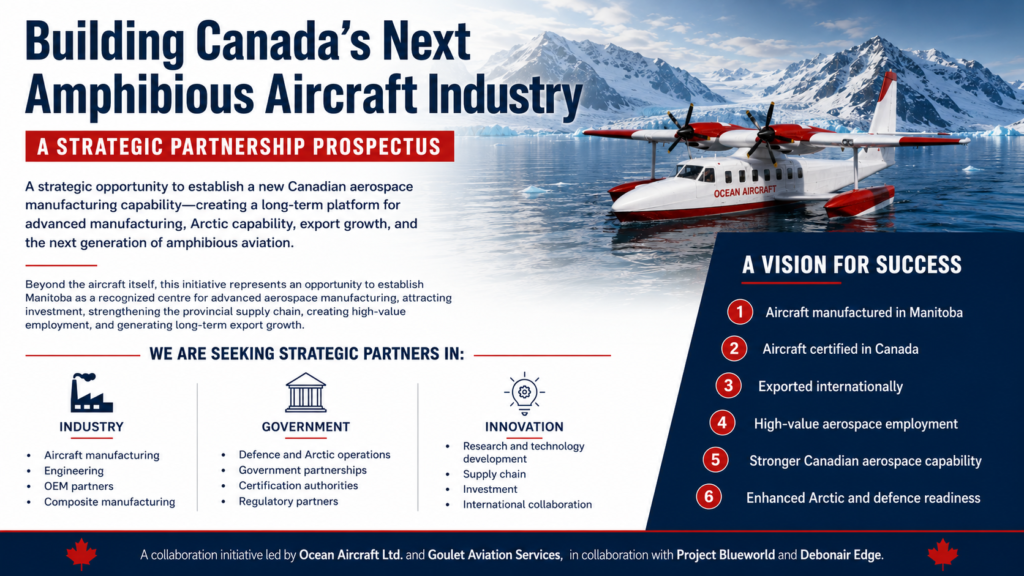
Ocean Aircraft Ltd of the United Kingdom has designed a family of new-technology amphibious seaplanes engineered for exactly the work Canada needs done. Two aircraft anchor the program:
- The Ocean 12, a single-engined amphibian in the 10-to-19-seat class, designed to take on the roles now served by Cessna Caravan and single Otter floatplanes.
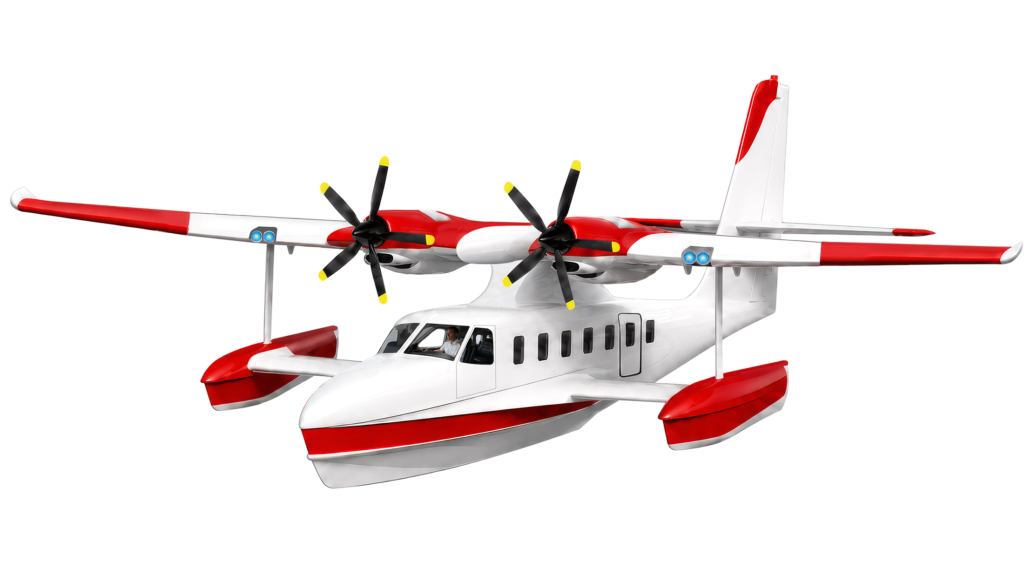
- The Ocean 18, a twin-engined amphibian in the 10-to-21-seat class, aimed squarely at the missions flown today by the venerable Twin Otter on floats.
The two types share largely the same airframe, which simplifies manufacturing, training, and support, and keeps operating economics competitive. Both feature modern hull forms offering roughly twice the wave-height capability of existing floatplanes, and composite airframes that shrug off the saltwater corrosion that has always punished aluminum seaplanes. Folding-wing options make them compatible with marine infrastructure, docks, and confined harbours. These are not restorations of old designs; they are clean-sheet aircraft built for coastal and northern operations in the twenty-first century.
The program has completed Phase One design and model testing and is primed to begin prototype construction on the path to certification. Ocean Aircraft owns the design and controls the program, and the company is actively pursuing Canadian manufacturing as the path to production, both for domestic requirements in the North and for civil sales worldwide.
Why Manitoba
Manitoba is home to Canada’s third-largest aerospace sector: roughly sixty companies and over five thousand skilled workers, with more than $1.6 billion in annual sales. Winnipeg hosts the country’s largest aerospace composite manufacturer along with world-class engine overhaul and component production. The composite fabrication skills that a modern seaplane demands already exist here at scale, alongside the flight-test conditions, the cold-weather expertise, and the working seaplane culture that shaped the original bush planes.
Just as important, Manitoba sits at the centre of the country, with direct rail, road, and air links east, west, and, increasingly, north. An aircraft built in Manitoba is built in the middle of its own market: thousands of lakes, hundreds of remote and Indigenous communities, and a coastline on Hudson Bay that is about to matter a great deal more to Canada.
The Churchill connection
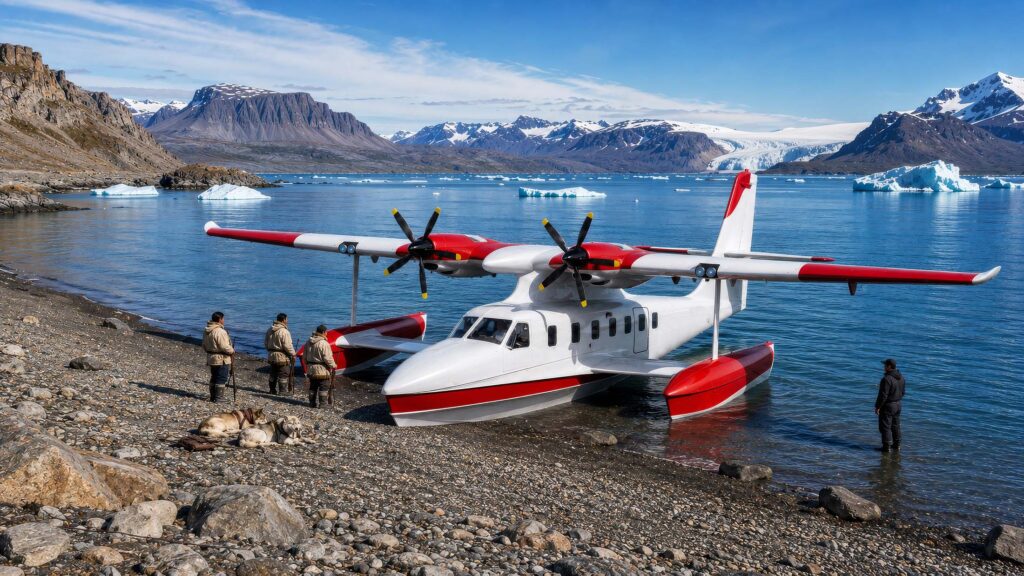
Churchill is Canada’s Arctic deep-water seaport with a direct rail connection, and it is the object of one of the most significant nation-building efforts now underway. The Port of Churchill Plus initiative, referred to the federal Major Projects Office, proposes upgrading the Hudson Bay Railway toward Class 1 standards, adding dedicated icebreaking capacity to extend the shipping season, building an all-weather road, and developing a new energy corridor. Federal and provincial governments have already committed more than half a billion dollars to the port and railway, and Canada is deliberately strengthening east-west trade corridors that reduce reliance on routes through the United States.
For an amphibious aircraft program, this is more than a happy coincidence. A revitalized Churchill needs aviation: maritime surveillance over an expanding shipping season, search-and-rescue coverage across Hudson Bay, and reliable links to the Kivalliq communities of Nunavut that look to Churchill as their gateway. An Ocean 18 configured for coast guard work, operating from a Churchill base, could patrol, respond, and resupply across a region where runways are scarce, and water is everywhere. The same corridor investment that moves grain and critical minerals through Churchill can anchor a northern aviation network, and the aircraft that serve it could roll out of a Manitoba factory at the southern end of that same railway.
A defence-industrial moment
The timing is no accident. In September 2025, the Canadian Coast Guard was transferred into the Department of National Defence, still civilian and unarmed, but now able to coordinate closely with the Canadian Armed Forces in the Arctic and to draw on defence procurement mechanisms. Canada’s Defence Industrial Strategy commits $81.8 billion to rebuilding defence capability over the coming decade, names Arctic sovereignty as a central justification, identifies aerospace platforms as a sovereign capability, and sets a target of awarding 70 percent of defence acquisitions to Canadian firms. A Canadian-built amphibian serving Coast Guard search-and-rescue, environmental response, and community resupply, alongside existing civil operators, is exactly the kind of dual-use capability this framework was designed to develop.
Missions that matter
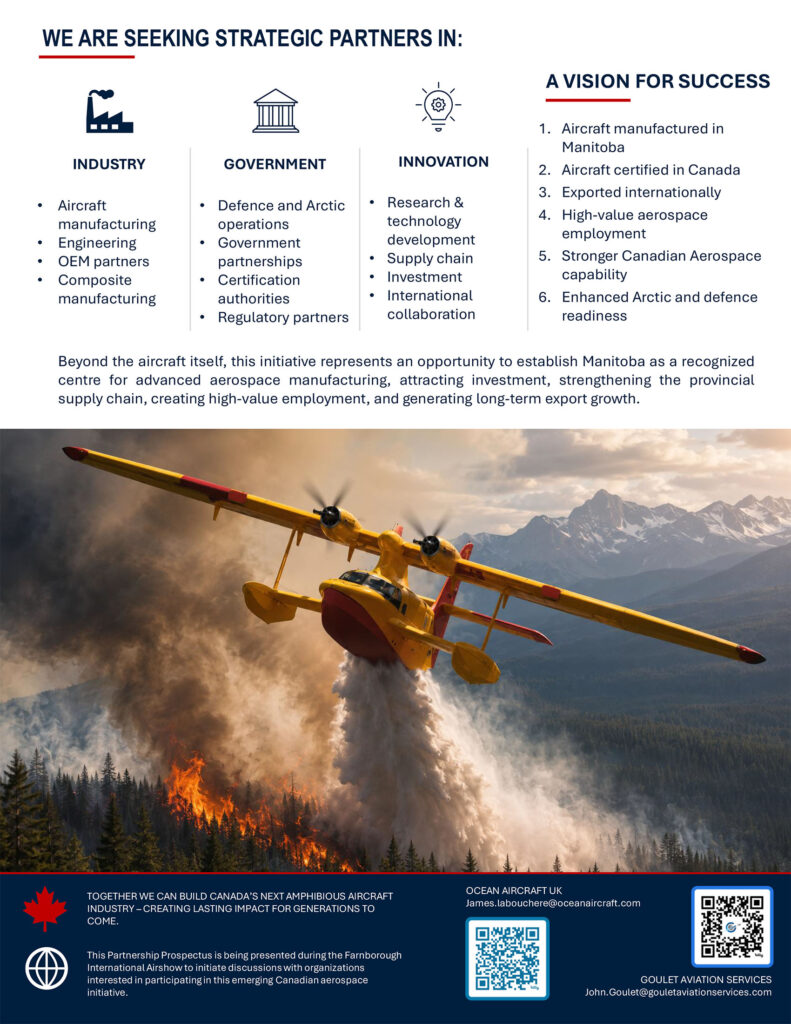
The market for these aircraft is not speculative; it is visible from any dock in northern Canada. Scheduled and charter services to communities without airstrips. Medevac and search and rescue. Fisheries and environmental patrol. Support for mining, hydro, and research operations. Sustainable, low-impact adventure tourism that brings visitors to remote lodges and coastal wilderness without carving new roads through it. And beneath all of it, a northern geography where runways sit on costly, degrading permafrost while a latent transportation network of lakes, rivers, and coastal inlets requires no construction and no annual maintenance, only an aircraft capable of using it.
An invitation
This week I am attending (or “attended”, depending on when you read this) the Farnborough International Airshow as a member of Canada’s delegation, together with Ocean Aircraft, to advance the case for manufacturing the Ocean family in Manitoba. We are speaking with governments, established aerospace companies, operators, and investors who see what we see: a proven mission set, an aging incumbent fleet with no modern replacement, a province with the industrial base to build the successor, and a northern gateway rising at Churchill.
Canada built the aircraft that opened this country. The opportunity in front of us is to build the ones that will keep it connected for the next fifty years. Let me know what you think.
Captain John Goulet is an aviation consultant specializing in the development and management of amphibious seaplane operations connecting remote communities for commercial development and sustainable tourism. Learn more at gouletaviationservices.com or connect on LinkedIn.
#aviation #seaplanes #aerospace #Manitoba #Churchill #ArcticGateway #madeinCanada