
The New Flying Boats Are Coming, and the Water Is Ready
Seaports and Waterdromes, Article 8 of 8 | By Captain John Goulet | Goulet Aviation Services
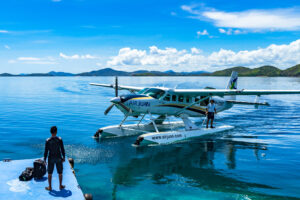
Twenty-five kilometres off the Saudi coast, in the Al Wajh lagoon, a resort opened in late 2024 that looks as if it were beamed in from a century ahead of us: seventy-three villas in mirror-polished stainless-steel orbs, floating above the reef, powered entirely by a dedicated solar farm. You can reach Shebara Resort by car and boat in about one hour from the airport, or by seaplane direct from the airport in 10 minutes. A trip from the world-class ultra-luxury Italian-designed Sindalah Yacht Club near NEOM to the Red Sea Shebara Resort takes anywhere from 6 hours by boat and car to 12 hours by air, depending on available flights. From yacht-side to resort-side, the hassle-free check-in-less journey takes 1:10 hours by seaplane. Sit with those statistics a moment, because it contains the entire argument of this final article.
The destinations of the future are already built. The regulations, as the last seven articles have shown, are already written. The seaports themselves cost a traffic scheme, a floating dock, and a windsock. The one piece of the system still catching up is the aircraft, and for the first time in my fifty years on the water, that piece is genuinely on its way. Not as a whispered conversation, not only as a concept drawing, but as four serious flying boat engineering programmes with metal ready to be cut and carbon fibre polymer ready to be formed, and every one of them amphibious.
The Fleet We Have Versus the Fleet We Need
Begin with an uncomfortable inventory. The commercial seaplane fleet of 2026 is magnificent, and it is old. The Beaver first flew in 1947, the Twin Otter in 1965, and the Caravan in 1982, and all three, as Article 1 explained, are landplanes standing on pontoons, inherently less seaworthy than the hulls they replaced. The widely publicized electric conversion of the Beaver deserves its applause, and I have given it mine, but let us be precise about what it proves: the propulsion, not the platform. Re-engining a 1947 airframe demonstrates that electric flight works; it does not give us an aircraft designed for the sea states, the passenger expectations, or the seaport infrastructure of the next fifty years. Article 1 planted the argument, and I will now harvest it: before the runways, flying boats ruled the water because ocean work demands a hull, and the return of commercial seaplane aviation to coasts, reefs, and open water demands hulls again, designed this century, with this century’s tools.
That is precisely what is happening. Computational fluid dynamics, composite structures, and electric and hybrid propulsion (on the water and in the air) have reopened a design space that closed in the 1950s, and four programmes in four countries, each making different technical bets, are building the successors. I have followed all four closely, and together they sketch the future of seaports better than any master plan I could draw.
Four Builders, Four Paths
Ocean Aircraft, United Kingdom. The programme closest to my own instincts. Ocean’s configuration takes its hull form from racing multihull yachts and fast ferries: a wave-piercing shape with roughly half the planing area of a conventional flying boat hull, presenting a stabilized multihull footprint on the water, which cuts drag on takeoff, carries more load on the same power, and slices through short steep waves that would collapse a floatplane’s supporting struts. Around that hull sit three ideas that read like a wish list from Articles 4 and 5 of this series: wings that fold on the water, opening five times more docks and marinas to the aircraft; an electrically powered water thruster for silent, precise, pollution-free berthing, no propeller blast, no shouting on the dock; and a cabin of up to seventeen passengers in the single-engined Ocean 12, twenty-one in the twin. And Ocean has made the decision I most respect: it starts with turbine power burning sustainable fuel, on an airframe designed from the outset to accept batteries, hydrogen, or hybrids when those technologies mature. That is certification realism, energy-density realism, and commercial realism in one choice. Aircraft earn revenue with engines that exist.
Jekta, Switzerland. The boldest of the four. The PHA-ZE 100, the name stands for Passenger Hydro Aircraft, Zero Emissions, is a clean-sheet nineteen-passenger amphibious flying boat, all-electric from day one, designed to accept either batteries or a hydrogen fuel cell, with retractable gear for runway operations. Subscale prototypes are flying, production is targeted for the beginning of the next decade, and the programme reports more than 1.35 billion US dollars in forward customer commitments, which tells you what the resort archipelagos and island nations think of a nineteen-seat zero-emission waterborne airliner. Where Ocean bets on pragmatism, Jekta bets that the operators who most need seaplanes, tropical, tourism-funded, and environmentally scrutinized, will pay for zero emissions the moment it is certifiable, and the order book suggests they are right.
NOEMI Aerospace, Norway. Formerly Elfly, and the most focused. Noemi is building a beautiful, sleek nine-passenger battery-electric flying boat, where every passenger gets a window seat, for the market their designers can see from its office window: Norway’s fjord coastline, where communities separated by hours of driving are minutes apart by water, sectors are short, and hydro-electric power is cheap and green. Around 200 kilometres of range with nine aboard sounds modest until you map it onto a fjord system, an island group, or, for that matter, a cruise port and its nearest three resorts. A full-scale prototype is under construction with first flight targeted for 2027. Noemi’s bet is that the electric seaplane does not need to beat the Caravan everywhere; it needs to beat the ferry somewhere, and there are a thousand somewheres.
Tidal Flight, United States. The range bet. The Polaris is a clean-sheet, composite, hybrid-electric amphibian for nine to twelve passengers, claiming 85 percent less fuel burn and 40 percent lower operating costs than the aircraft it replaces, cruising at about 160 knots, and, the number that matters, carrying a thousand kilograms over roughly a thousand nautical miles. That is not an island-hopper; that is an aircraft that connects a mainland seaport to an entire coastline. First flight is targeted for 2027, with service entry around 2030. An established Florida and Bahamas seaplane operator has already signed for the type, which is the endorsement I weigh most heavily: the customers who know the saltwater best are buying the hybrid.
Who wins? Everyone. These four are not competing for a fixed market; they are dividing an unserved one. Set aside the small fleet of today’s seaplane operators and count instead the coastal, lake, and river communities that have water, trade, and travellers but no airport and no realistic prospect of one: the number runs to thousands of potential commercial and community hubs on every inhabited continent. No single design can serve them all, and no single design has to. The nineteen-seat electric suits the resort archipelago; the nine-seater suits the fjord and the island community; the thousand-mile hybrid suits an entire coastline; the folding wing suits the marina city. Better still, they help each other: every certification that succeeds proves the water runway for all of them, and every new route makes the next one easier to approve. Operators win, resorts win, remote communities win, and governments watching their budgets win, because a floating dock and terminal costs less than a kilometre of road, and a fleet of these amphibious wonders costs less than one new airport. I am aware that I am preaching. The difference, this time, is that the choir is finally assembling.
The four of the best, side by side:
| Ocean (UK) | Jekta PHA-ZE 100 (Switzerland) | Noemi (Norway) | Tidal Polaris (USA) | |
| Seats | Up to 17-19 passengers (single or twin) | 19 passengers, 3 crew | 9 passengers, 2 crew | 9-12 passengers |
| Propulsion | Turbine first (SAF-capable); airframe designed to accept battery, hydrogen, or hybrid later | All-electric: battery or hydrogen fuel cell | All-electric: battery | Hybrid-electric: 85% less fuel, 40% lower operating cost |
| Signature innovations | Wave-piercing multihull, on-water wing-fold, electric water thruster for silent berthing | Clean-sheet 19-seat electric flying boat hull with retractable gear | Purpose-built electric flying boat for short fjord and coastal sectors | Long range with meaningful payload: about 1,000 nm with 1,000 kg |
| Published timeline | Phased development; docking and water trials early in the programme | Subscale prototypes flying; production targeted 2030-31; US$1.35 billion in commitments | Full-scale prototype in build; first flight targeted 2027 | First flight targeted 2027; certification 2029; service from 2030 |
[IMAGE 2 – FIGURE] Caption: Four programmes, four countries, one conclusion: the next commercial seaplane is an amphibious flying boat.
What the New Aircraft Change About the Seaport
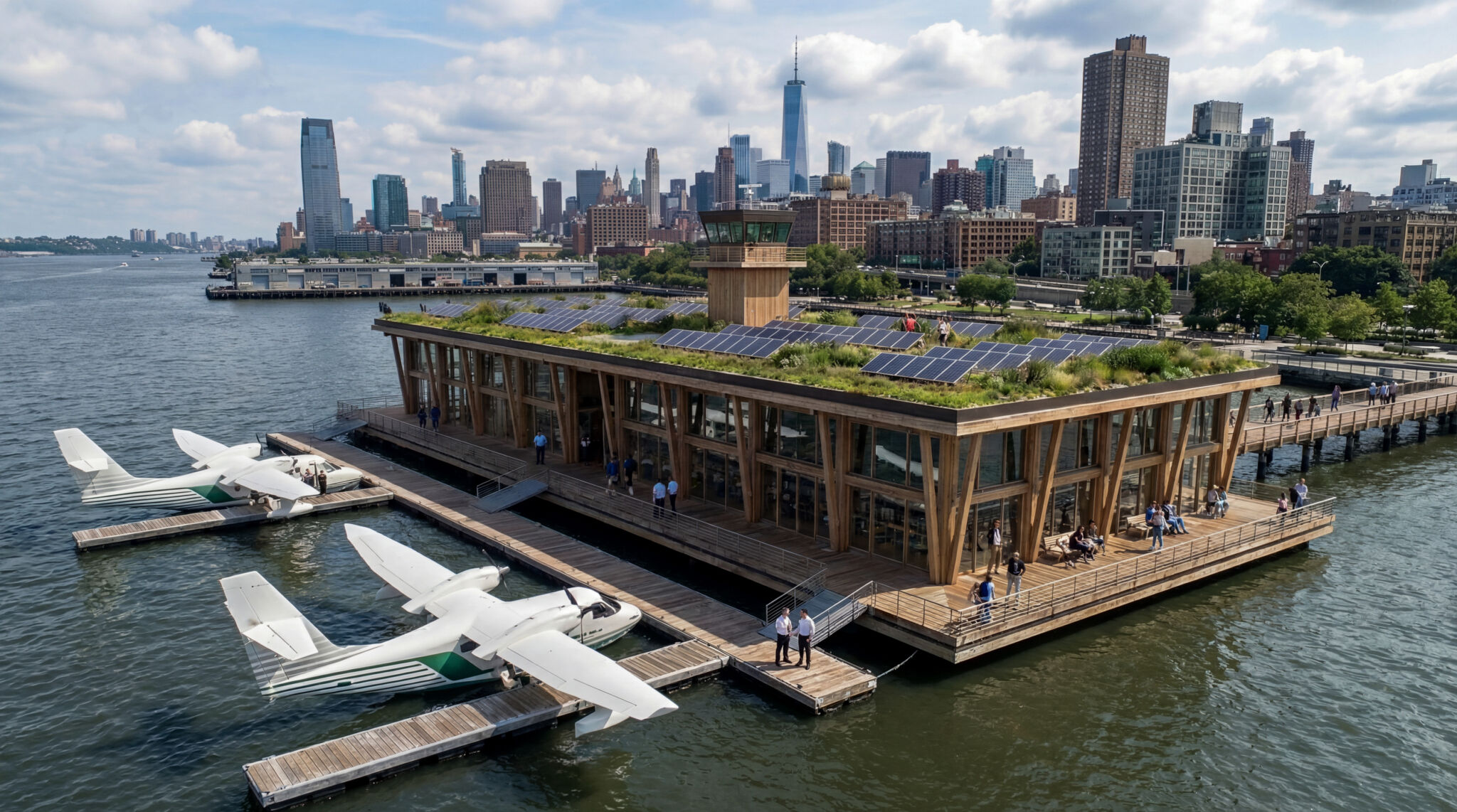
Now put the pilot’s headset aside and put on the port planner’s hard hat, because these aircraft rewrite pieces of the infrastructure conversation this series has been having, almost entirely in the seaport’s favour. Start with what does not change: the water. A thousand metres by sixty, the turning basins, the taxi channels, and the traffic schemes of Article 6 serve a NOEMI or a PHA-ZE 100 exactly as they serve a Twin Otter, and the route guides and SMS of Article 7 transfer without an amendment. For the first time in aviation history, the paperwork is ready before the airplanes are.
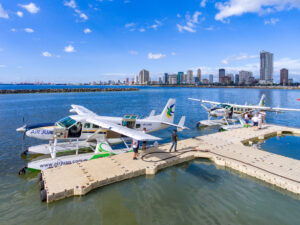
The dock is where it gets interesting. A properly designed seaport, and by now you know what I mean by that, a low floating platform with fendering, port-side layout, and clear water, will accommodate any of these aircraft with fixed wings spread. But the wing-fold changes the economics of everywhere else. An aircraft that can fold its wings on the water and berth in a marina slip is an aircraft that can call at hundreds of existing waterfronts that will never build a waterdrome, and Ocean’s own analysis puts the multiplier at five times more accessible coastal facilities. The future seaport network, in other words, is two-tiered: purpose-built waterdromes at the hubs, serving everything, and marina berths at the spokes, serving the folding wings. Planners should design the hub for the fixed wing and treat the folding wing as a bonus rather than an assumption.
Electric and hybrid propulsion resolve the two objections that have killed more urban seaplane proposals than safety ever did: noise and exhaust. A flying boat that approaches the dock under a silent electric water thruster, or departs on battery power, changes the conversation with every waterfront hotel, harbour residents’ association, and environmental regulator on the coastline, and it does so just as waterfronts everywhere are electrifying anyway. Which raises the seaport’s one genuinely new duty: energy. The dock of Article 4 needs a new column in its budget: charging capacity for electrics and hybrids. The elegant precedent is already in place at Shebara, where a solar farm powers an entire resort. A seaport developer breaking ground today should build for turbines and hybrids, and lay the conduit for electricity, because the cheapest time to future-proof a dock is while the concrete is wet.
And the hulls change the schedule. The seaworthiness argument from Article 1 lands here with commercial force: wave-piercing hulls that operate in sea states that ground today’s floatplanes mean fewer cancellations, and fewer cancellations mean timetables that can be sold to a cruise line, an airline codeshare, or a commuting public. The old flying boats, designed in the 1930’s and ‘40s before modern composites and when aluminum was new to fabricators, were retired by the runway; the floatplanes that replaced them accepted a fair-weather compromise. The new generation refuses both, and reliability, more than speed or range, is what will make the seaport a scheduled destination rather than an excursion.
The Realist’s Timeline
A word of seasoned caution, because I have witnessed seaplane revivals announced before. Certification is slow, batteries are heavy, and at least one of any four ambitious programmes will slip its dates; that is not cynicism, it is statistics, and my money is on the turbine and the hybrid to fly revenue first for exactly the reasons Ocean and Tidal have engineered around. But the direction is no longer in doubt, the capital is real, the order books are real, and the prototypes are in build. For the operators, port authorities, and regulators who have read this far, the practical counsel is simple: nothing about the new aircraft asks you to wait. Every seaport, traffic scheme, route guide, and SOP in this series serves the Caravan and Twin Otter today and the NOEMI and PHA-ZE 100 in 2031. Build now, fly what exists, and let the new fleet arrive at a network that is ready for it.
Full Circle
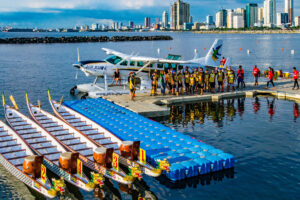
This series began in Manila Bay in 1935, with a Martin flying boat arriving at a harbour that was an international airport before the city had a runway. It ends twenty-five kilometres off the Saudi coast, where mirrored villas float above a reef, waiting ten minutes by seaplane from a mainland where new cruise terminals are rising nearby on the same water. Between those two images sit eight articles of vocabulary, law, surveys, docks, choreography, traffic schemes, and paperwork, a complete, published, audited system for operating aircraft from water, assembled over a century by pilots, harbour masters, and regulators who mostly never met. The harbours were the world’s first airports. The aircraft that deserted them for the runways are coming back as something better than they left, seaworthy hulls with folding wings and quiet engines, and this time the water is ready: the rules written, the docks drawn, the route guides templated, the precedents certified. Fifty years I have waited for the industry to catch up to its own history. It has been worth the wait, and I intend to be on the dock, holding the wing rope, when the future comes alongside.
References
Ocean Aircraft Ltd (oceanaircraft.com): business plan and technical material on the Ocean 18 and family, hull form, wing-fold, electric water thruster, and phased propulsion strategy.
Jekta Aviation (jekta.swiss): PHA-ZE 100 specifications, subscale flight testing, customer commitments, and production timeline.
Noemi Aerospace, formerly Elfly (noemi.aero): nine-passenger battery-electric amphibian, CS-23 commuter certification basis, prototype build and first-flight target.
Tidal Flight (tidalflight.com): Polaris hybrid-electric amphibian specifications, efficiency claims, operator agreement, and development timeline.
Red Sea Global / Shebara Resort, Sheybarah Island, Al Wajh lagoon (opened November 2024; solar-powered; boat or seaplane access).
Earlier articles in this series, in particular Article 1 (seaworthiness and the flying boat inheritance), Article 4 (dock and energy infrastructure), Article 6 (port integration models), and Article 7 (documentation).